Search “best MBA Singapore” and you’ll land on the same two names within seconds. NUS. NTU. Both genuinely excellent, both backed by rankings that hold up to scrutiny. If prestige and a well-known local ranking is what you’re optimising for, the search is basically over before it starts.
But that’s not actually the question most working professionals are trying to answer. “Which is best” assumes there’s a single scale everyone should be measured on. The more useful question is narrower and more personal: which programme is built for the specific career outcome you’re trying to reach. Once you ask it that way, NUS and NTU become the starting reference point rather than the final answer, because the criteria that matter shift depending on what you actually want out of the degree.
Singapore's Strongest Local Options Deserve Recognition
Let’s be clear about something first. NUS and NTU are not included here as a setup for a takedown.
NUS Business School has held the number one spot in Asia in the QS Global MBA Rankings for three consecutive years, most recently climbing to 23rd globally out of 390 ranked programmes. That’s not a marginal result. NTU carries its own strong track record too, with consistently solid regional graduate outcomes and a reputation that opens doors across Southeast Asia specifically.
Both schools also run part-time formats built for working professionals, which is worth noting because flexibility on its own isn’t a differentiator anymore. Every serious MBA option in Singapore, local or international, now offers some version of evening, weekend, or blended study. If flexibility was the whole decision, there’d be nothing left to compare.
So this isn’t NUS and NTU versus everyone else. It’s a genuinely strong pair of options that happen to answer one specific version of the question well. The real work is figuring out whether that’s the version you’re actually asking.
A Different Question Worth Asking
Rankings measure something real, but they measure it at the institutional level, aggregated across every graduate, every specialisation, every outcome. They don’t measure the thing you personally care about, which is usually much more specific than “is this school good.”
A more useful evaluation looks at five criteria instead of one composite score:
Who actually awards the degree. A local institution’s own qualification, or a degree conferred directly by an international university.
Accreditation you can independently verify. Not a marketing claim, but a credential checkable against a public register.
The kind of network you’re buying into. Regional, global, or genuinely both.
Whether the curriculum was designed for working professionals from day one, or adapted afterward to fit around a job.
What local, in-person support actually looks like once you’re enrolled.
The rest of this article walks through each of those five criteria in order, using the Manchester Global MBA as the working example, not because it’s the only alternative worth considering, but because it happens to answer these five questions in ways that are structurally different from a locally-conferred degree, which makes the contrast genuinely useful.
Before getting into each criterion in detail, three specific advantages worth flagging upfront, since they come up often in conversations with prospective students:
Portability. You can start the programme in Singapore and continue it elsewhere, such as Hong Kong or Dubai, without switching institutions or restarting.
UK-based faculty. Teaching staff fly in directly from Manchester rather than the curriculum being adapted by a separate regional teaching team.
A global alumni network, not only a local one. More than 550,000 Manchester graduates across 190 countries, layered on top of the local Singapore cohort and support.
Criterion 1: Who Actually Awards the Degree
This is the first fork in the road, and it’s easy to miss because the marketing on most programme pages doesn’t dwell on it.
An NUS or NTU MBA is conferred by the Singapore institution itself. That’s not a weakness. Both are internationally respected universities in their own right, and the degree carries their name and reputation directly.
The Manchester Global MBA works differently. It is awarded directly by the University of Manchester, the same MBA qualification as candidates who study on campus in Manchester. There’s no “Singapore version” printed on the certificate, no asterisk, no separate designation. It’s the same qualification, issued by the same institution, regardless of where in the world you completed it.
This is a structural difference, not a claim that one is superior to the other. What it changes is how the degree reads outside Singapore, particularly to an employer or admissions committee in a market where the University of Manchester’s name carries its own independent weight.
Criterion 2: Accreditation You Can Verify
Anyone can write “internationally accredited” on a website. Fewer institutions can back that claim up against a public, checkable register.
Alliance Manchester Business School holds triple accreditation from AMBA, AACSB, and EQUIS, a combination held by fewer than 1% of business schools worldwide. That’s not a self-declared badge. All three accrediting bodies publish their accredited institution lists publicly, which means the claim is verifiable in minutes rather than something you have to take on trust.
Where the University Stands Globally
The University of Manchester was founded in 1824 and counts 26 Nobel Laureates among its alumni and faculty. Its standing on public record includes:
None of that replaces doing your own due diligence on any programme you’re considering. But it does mean the underlying institution’s credentials sit on public record, not on a page written by the institution about itself.
Criterion 3: A Global Network, Not Only a Regional One
Here’s where the picture genuinely broadens rather than just differs.
The Manchester alumni network runs to more than 550,000 people across 190 countries, with over 60,000 of those specifically from Alliance MBS across 176 countries. That’s not a Singapore-and-Southeast-Asia network. It’s a global one, and the distinction matters most if your career ambitions extend beyond the region.
It shows up in the programme structure too:
Overseas elective workshops run in Dubai, Hong Kong, Manchester, and Shanghai, with accommodation covered in two of those locations.
Five global centres mean genuine portability. A student can start in Singapore and continue in Hong Kong or Dubai mid-programme without missing a beat, something a locally-conferred degree structurally can’t replicate in the same way.
Faculty fly in directly from Manchester, rather than the curriculum being adapted by a separate regional teaching team, which keeps the content consistent with what’s taught on the UK campus itself.
None of this makes a regional network less valuable. If your career is staying firmly rooted in Singapore or Southeast Asia, the depth of a local alumni base and employer relationships built over decades has real, practical weight that a global network doesn’t automatically replicate. The honest framing is that these are two different kinds of asset, not a better one and a worse one.
Criterion 4: A Curriculum Built for Working Professionals, Not Adapted for Them
There’s a meaningful difference between a programme designed from the ground up around a working schedule, and a full-time curriculum with the timetable rearranged afterward to accommodate evening classes.
The Manchester Global MBA is delivered through blended learning, combining online study with in-person workshops. It runs as three pathways, each with its own duration and entry profile:
Global MBA
Global MBA Accelerated
Global MBA Finance Accelerated
Duration
24 months
18 months
18 months
Format
Part-time blended learning: face-to-face workshops plus online learning
Part-time blended learning: workshop residentials plus online learning
Part-time blended learning: workshop residentials plus online learning
Awarding body
The University of Manchester
The University of Manchester
The University of Manchester
Intakes
January and July
January and July
January and July
Entry profile
At least three years of postgraduate work experience
At least eight years of postgraduate experience, including managerial responsibility
At least three years of postgraduate experience plus a professional finance qualification such as ACCA, CIMA, CPA, or CFA
Two things worth reading into that table. The Accelerated pathway expects a noticeably more senior profile than the standard 24-month route. And the Finance Accelerated pathway is an entry route for candidates who already hold a professional finance qualification, not a separate specialisation you choose from the standard cohort.
Assessment is 100% coursework-based across all three, with no timed exams anywhere in the programme. That’s a deliberate philosophy rather than a convenience feature. Applied assessment, tied to real business problems you’re actually solving, tests something closer to what the degree is meant to build than a three-hour written exam does. It also fits naturally into a working professional’s actual working method, since most senior roles are judged on applied output, not on how well someone performs under exam-hall conditions.
Criterion 5: Local Presence, Backed by a Global Institution
The last criterion is the one people underestimate until they’re actually enrolled and need it.
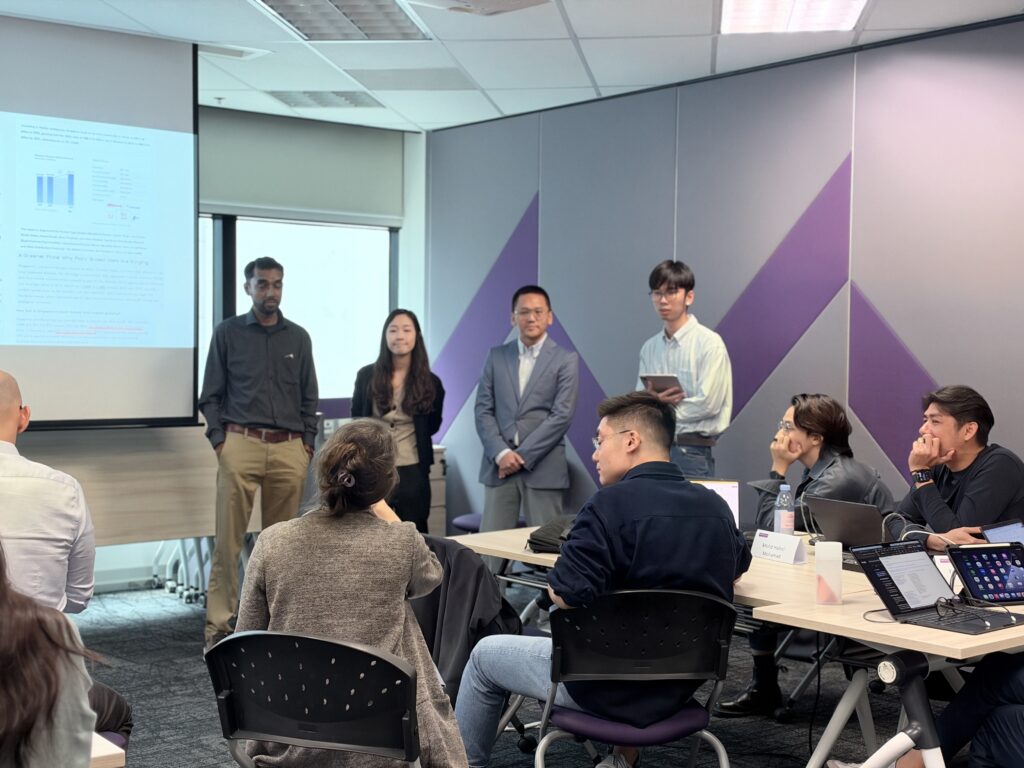
Manchester is the only major UK university with a wholly-owned physical centre in Singapore, based at 80 Robinson Road in the heart of the CBD. That matters more than it sounds. It means in-person support, workshop sessions, and a physical community that exists locally, paired with a degree conferred by an institution based thousands of kilometres away.
The cohort itself reflects that same blend of local grounding and global reach: 21 nationalities, 20-plus industry sectors, studying together in the evenings and on weekends alongside working peers who are navigating the exact same balancing act you are. It’s not a purely online relationship with a distant institution, and it’s not a purely local one either. It’s genuinely both at once.
The Bottom Line
None of this is a case against NUS or NTU. They remain strong, legitimate, well-earned choices for a Singapore MBA, and for a specific kind of career trajectory, particularly one staying firmly regional, they may well be the better fit.
What the Manchester Global MBA offers instead is a different answer across the same five criteria: a degree conferred directly by the University of Manchester rather than a locally-issued qualification, triple accreditation you can independently verify, a genuinely global alumni network layered on top of local support, a curriculum built from the ground up around working professionals rather than retrofitted for them, and a physical Singapore base backed by an institution with nearly two centuries of history behind it.
The right question was never “which MBA is best.” It’s which MBA is actually built for the career you’re trying to build. If you want to talk through how that maps onto your own situation, reach out to the team in Singapore directly.
You might be interested:
Why Triple Accreditation Matters When Choosing Your… When most professionals research an MBA, they compare delivery formats, read student reviews, and check rankings. Very few check accreditation. Yet for many senior hiring…
Operationalising and Communicating Value –… Every organisation makes promises to its customers. Marketing writes them, and operations has to keep them. When the two functions drift apart, a campaign promises…
Singapore professionals face IP commercialisation challenge The Alliance Manchester Business School has introduced its inaugural SkillsFuture-listed short course in Singapore, designed to assist professionals in transforming ideas and intellectual property (IP)…