Beyond the Finance Team:
Who Studies Financial Statement Analysis, and Why
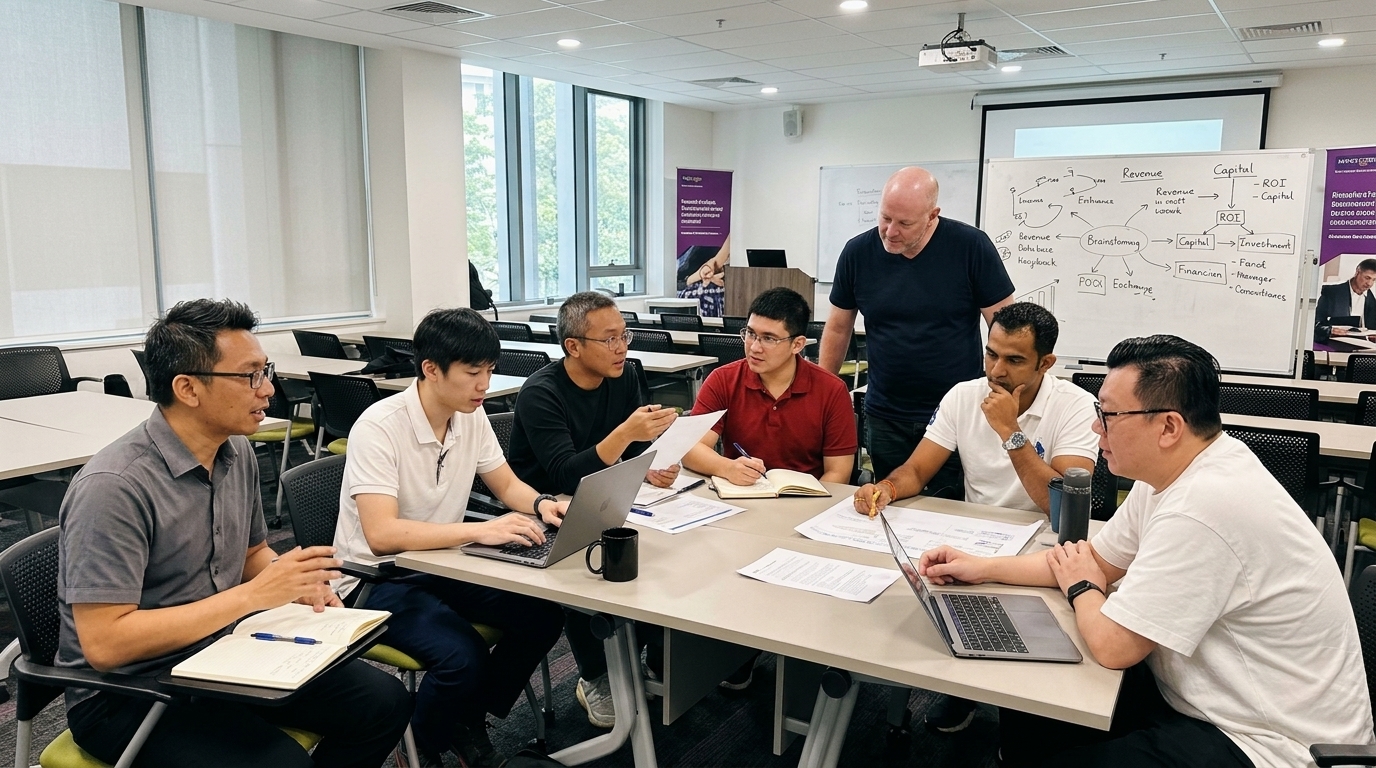
A workshop called Financial Statement Analysis sounds like a room full of accountants. Ours is something else: an auditor sits beside a power engineer, a technology company director beside a head of finance, and a law graduate beside an engineering manager from a manufacturing group.
They have travelled from Singapore, Indonesia and Hong Kong to study the same three documents: the income statement, the balance sheet and the cash flow statement. The mix of people in the room says a good deal about who needs this skill today.
Who is in the room
The cohort’s first degrees cover accounting and finance, business, law, the arts and several branches of engineering, from power to agricultural. Their universities are as varied, spanning Malaysia, Indonesia, China, Australia and the United Kingdom, including a Manchester engineering graduate returning to the University for a second time.
Their roles are just as broad:
Finance specialists, including an assurance senior at an audit firm and heads of finance in shipping and agribusiness
Engineers and engineering managers working in energy and food manufacturing
General managers and directors, including the director of a technology company Some of them prepare or audit financial statements for a living. Others have spent their careers building, running or advising the operations those statements describe.
Some of them prepare or audit financial statements for a living. Others have spent their careers building, running or advising the operations those statements describe.
Why the numbers matter outside the finance function
Financial statements are the one account of a business that every stakeholder reads: lenders, investors, regulators, suppliers and boards. A manager who cannot interpret them depends on someone else’s summary of their own organisation.
That dependence becomes costly as responsibility grows. An engineer who moves into management starts to defend capital budgets. A director signs off accounts and answers for them. A commercial lead needs to judge whether a customer, supplier or acquisition target is as healthy as it claims.
The finance specialists in the room face the opposite challenge. They know how the statements are built, and the harder question for them is what the figures say about strategy, risk and the quality of a company’s earnings. Working through a case with colleagues who run plants and projects supplies the operating context a spreadsheet leaves out.
One discipline, several markets
A cohort drawn from Singapore, Indonesia and Hong Kong brings a second kind of diversity. The same ratio can mean different things in different places. Typical levels of debt, ownership structures, the role of family and state shareholders, and the depth of local capital markets all shape how a set of accounts should be read.
Participants who work across these markets bring that knowledge with them. A question about a company’s cash position or its related-party transactions draws a different answer from someone who has worked in Jakarta than from someone based in Hong Kong, and both answers improve the analysis.
The Manchester approach
Financial statement analysis is an established subject at Alliance Manchester Business School. The School’s teaching treats ratio calculation as the starting point. The larger task is interpretation: reading a company’s figures against its strategy, weighing what different stakeholders need to know, and judging how reliable the reported numbers are.
That emphasis suits a room of working professionals. Each participant can take the method back to the organisation they know best, their own, and test it on real figures the following week. It is the University’s promise in practice: original thinking, applied.
Reading a business, together
Financial statements were once treated as the finance department’s property. This cohort suggests a different view is taking hold across the region: that reading them is a general management skill, and that it is learned best alongside people who see the business from another angle.
You might be interested:
Fireside Chat: Tesla & Corporate Finance – Strategy… What happens when bold ambition meets financial strategy? Step into the world of Tesla—where innovation, risk, and corporate finance collide. This exclusive fireside chat goes…
Banking on a Greener Tomorrow: Sustainable Finance… As we look to the future of banking this World Financial Planning Day, it’s clear that the concept of “sustainable banking” has gained significant traction…
Sustainable Finance in Action: Unlocking… Be Part of the Sustainable Finance Revolution! 🌿💼 Discover how sustainable finance is reshaping Malaysia's economic landscape. This exclusive masterclass delves into the transformative power of Environmental, Social,…