When most professionals research an MBA, they compare delivery formats, read student reviews, and check rankings. Very few check accreditation. Yet for many senior hiring managers, it is the first thing they look for on a candidate’s CV.
In Singapore’s crowded MBA market, with close to 20 business schools offering postgraduate business programmes, accreditation is the quality signal that most candidates overlook and most good employers quietly check. A school’s ranking can shift year to year. Its accreditation status reflects years of rigorous, independent evaluation that no marketing brochure can replicate.
Understanding what triple accreditation means, why it carries particular weight in Singapore, and how to verify it before you enrol is one of the most important steps you can take when choosing your MBA.
What Triple Accreditation Actually Is
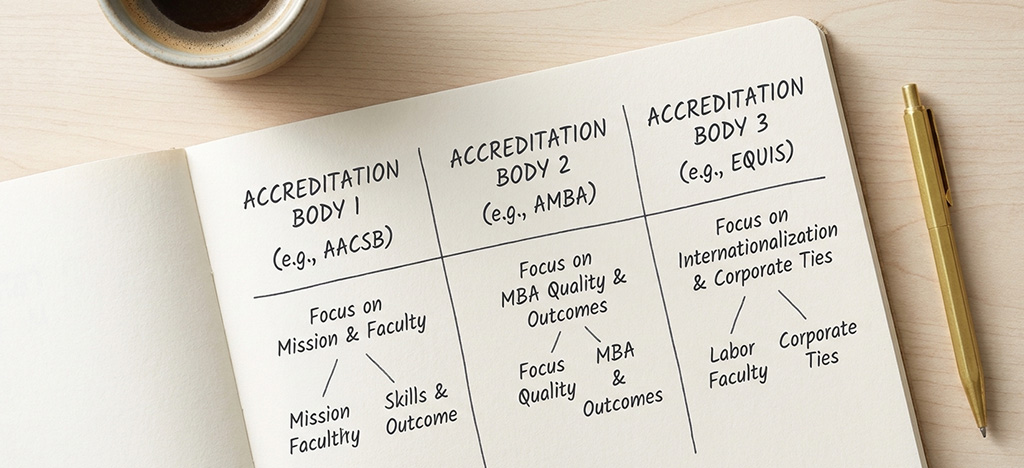
Triple accreditation, also called the “triple crown,” means a business school simultaneously holds accreditation from all three of the world’s leading independent business school accreditation bodies: AACSB, AMBA, and EQUIS.
Each assesses something different, and that is precisely the point.
AACSB (Association to Advance Collegiate Schools of Business), founded in the United States in 1916, is the oldest and largest specialist accreditor. It reviews the entire institution against nine standards spanning strategic management, learner success, and thought leadership. Only around 6% of schools worldwide hold AACSB accreditation, making it one of the most selective recognitions in higher education.
AMBA (Association of MBAs), based in London and founded in 1967, is the only one of the three that focuses specifically on the MBA and postgraduate portfolio rather than the institution as a whole. It accredits the top 2% of schools worldwide, and uniquely requires that MBA candidates have meaningful postgraduate work experience. This is a standard most US schools cannot meet, which is why Harvard, Stanford, and Wharton hold AACSB but not AMBA.
EQUIS (EFMD Quality Improvement System), run by the European Foundation for Management Development in Brussels and founded in 1997, reviews the whole institution with particular emphasis on internationalisation, corporate connections, ethics, responsibility, and sustainability. EQUIS covers 234 institutions across 45 countries.
Holding all three simultaneously means a school has been independently validated at both the institutional and programme level, across American, European, and British standards at the same time. As AMBA itself states, a triple-accredited school “offers a guarantee of quality” that transcends individual programmes and permeates throughout an institution.
Crucially, none of these accreditations are permanent. Each is reassessed every five years, meaning the badge signals continuous improvement and ongoing standards, not a one-time achievement from decades ago.
How Rare Is It?
The numbers tell the story clearly. As of February 2026, only 149 business schools worldwide hold triple accreditation, roughly 1% of all business schools globally. Earning just one of the three accreditations is difficult, typically taking between three and five years from a standing start. Earning all three reflects an institution’s exceptional and sustained commitment to quality across every dimension of its operation.
To put this in perspective: there are estimated to be over 13,000 business schools worldwide. Fewer than 1% qualify. When you choose a triple-accredited MBA, you are choosing from a field that has already been comprehensively filtered.
Why It Matters More in Singapore Than Almost Anywhere Else
Singapore presents a specific challenge that makes international accreditation not just valuable but essential.
Singapore’s private education sector is regulated by SkillsFuture Singapore (SSG) through the Enhanced Registration Framework. But SSG is explicit about the limits of that regulation. The official position is that registration does not represent an accreditation of the institution or the quality of courses offered, and that there is no central authority in Singapore that accords recognition to certificates and qualifications. EduTrust certification, the voluntary scheme for private education institutions, equally does not assess course content or academic quality.
In other words, the Singapore state deliberately leaves academic quality assurance to other parties. For a Singapore-based candidate evaluating a business programme, international triple accreditation is not a redundant extra on top of local regulation. It is the only rigorous, independently verified academic quality signal available.
This matters even more against Singapore’s well-documented history with credential fraud. An average of 660 foreigners have been permanently barred each year from working in Singapore for submitting fake education qualifications in work pass applications, according to MOM data. Singapore has appeared on international watchlists for degree mill activity, and MOM disregards unaccredited degrees entirely in work pass evaluations. In a market where credential scrutiny is this high, a degree from a verifiable, triple-accredited institution is the cleanest professional signal you can carry.
The proliferation of online MBA programmes in recent years has made this issue sharper, not softer. With the unaccredited MBA market expanding rapidly, a quality filter has become more valuable, not less. Accreditation is the most efficient way for a candidate, and for an employer checking their CV, to separate rigorous programmes from the rest.
The Competitive Landscape in Singapore
Understanding accreditation in Singapore requires knowing where the local schools actually stand, because the picture is more uneven than most marketing materials suggest.
Among Singapore’s autonomous universities, SMU Lee Kong Chian describes itself as “Singapore’s only triple-crown accredited business school.” NUS Business School and NTU Nanyang Business School both hold AACSB and EQUIS, but neither holds AMBA, meaning neither is triple-accredited. This is a distinction that is rarely surfaced in their marketing. INSEAD and ESSEC, both with Singapore campuses, are triple-accredited international institutions.
Alliance Manchester Business School, which delivers the Manchester Global MBA through its wholly-owned Singapore centre at Robinson Road, is triple-accredited by AMBA, AACSB, and EQUIS, and awards the same University of Manchester degree as its on-campus programme in the UK.
The practical implication: if you are evaluating MBA programmes in Singapore and triple accreditation matters to you, your shortlist realistically narrows to a small group. And within that group, the Manchester Global MBA is the only option combining triple accreditation, a part-time blended-learning format built specifically for working professionals, and a globally portable UK university degree awarded by one of the world’s leading research universities.
What Employers Actually Check
The employer perspective on accreditation is consistent and growing more rigorous.
According to AACSB, 73% of CEOs at Fortune 100 companies and 75% of the top-paid CEOs at S&P 500 companies hold a business degree from an AACSB-accredited school. AMBA frames accreditation in direct hiring terms: “recruiting AMBA graduates is recruiting top talent.” A Singapore Institute of Management publication noted that 83% of employers believe accredited degrees signal job-readiness, with accreditation serving as the trust mechanism that makes that confidence possible.
In Asia-Pacific specifically, employer recognition of triple-accredited programmes is high and growing. Singapore is a regional headquarters hub, and its professionals move across ASEAN, Greater China, the Middle East, and beyond. A triple-accredited MBA is simultaneously recognised across all three of the world’s major accreditation systems, making the qualification portable across the markets a Singapore-based career actually spans.
The 2026 environment has raised the stakes further. With AI compressing the value of routine analytical skills, employers are doubling down on credentialled strategic thinkers and leaders. A rigorous, internationally verified MBA signals exactly the human judgement, leadership capability, and strategic thinking that employers say they cannot find enough of.
What to Check Before You Enrol
Accreditation status is publicly verifiable. Do not rely on a brochure.
Because AMBA accredits the MBA portfolio specifically rather than the institution as a whole, confirm that your specific programme, whether part-time, executive, online, or full-time, is explicitly within the accredited scope and not just the school in general.
Confirm that the degree is awarded by the home university and is identical to the on-campus award. For programmes delivered in Singapore by an international institution, this parity is essential. The Manchester Global MBA is awarded directly by the University of Manchester and carries exactly the same qualification as the degree earned by students studying on campus in the UK.
Check renewal dates. Accreditations lapse and must be renewed on a five-year cycle. A school that was triple-accredited five years ago may not be today. Always confirm current status.
Finally, separate two distinct questions when evaluating any Singapore-delivered programme. Is the local provider properly registered with SSG? And is the academic award internationally accredited? Both questions matter. Only the second is answered by the triple crown, and only the second tells you whether your degree will be recognised by employers globally.
The Bottom Line
Triple accreditation is not a marketing label. It is an independently verified, continuously renewed signal that a business school has met rigorous standards across teaching quality, research, internationalisation, ethics, and graduate outcomes, evaluated simultaneously by three separate bodies operating on three different continents.
In Singapore, where no government body assesses the academic quality of private programmes, and where credential scrutiny from employers and MOM is growing stricter, that independent signal carries more practical weight than almost anywhere else in the world.
Fewer than 1% of business schools globally have earned it. The question worth asking before you commit to an MBA is a simple one: is yours one of them?
Alliance Manchester Business School is triple-accredited by AMBA, AACSB, and EQUIS, and ranks 5th in the UK for MBA. The Manchester Global MBA is delivered part-time in Singapore through a blended learning model designed for working professionals, with no exams and 100% coursework assessment. Get in touch to find out more.
AMBS retains triple status with five-year… Alliance Manchester Business School (AMBS) has achieved five further years of re-accreditation from EQUIS – the European Foundation for Management Development (EFMD) Quality Improvement System. EQUIS…