The question has never been more pressing or more personal. With artificial intelligence reshaping how businesses operate, Singapore’s government pouring resources into workforce transformation, and employers growing more selective in who they promote, the working professional in 2026 faces a genuine fork in the road: stay put and upskill incrementally, or make a strategic investment in yourself that compounds over decades.
For many, that investment is an MBA. But is it still worth it in a world where AI can draft a business strategy in seconds? Here is what the evidence says.
A Labour Market That Rewards Relevance
Singapore’s job market in 2026 is, as one recruiter analysis put it, “stable on the surface but increasingly tight underneath.” According to an analysis of Singapore’s Ministry of Manpower (MOM) 2025 Labour Report, hiring is no longer driven by expansion alone. Employers are becoming more selective, and career mobility increasingly rewards those who can demonstrate relevance, adaptability, and skills alignment (Reeracoen Singapore).
The sectors seeing the most growth are professional services, information and communications, financial and insurance services, and health and social services, precisely the industries where MBA graduates are most in demand (MOM Labour Market Report, via UpGrad SG).
Singapore’s Budget 2026 sent an equally clear message about continuous learning. Prime Minister Lawrence Wong announced a National AI Council, expanded AI training under the Smart Nation 2.0 and AI Strategy 2.0 frameworks, and a merger of Workforce Singapore and SkillsFuture Singapore into a single statutory board (NTUC, February 2026). A new S$300 per month part-time training allowance was introduced to support Singaporeans pursuing courses while employed (SkillsFuture, Budget 2026). Standing still is no longer an option.
What an MBA Actually Delivers in 2026
A Measurable Salary Premium
The data on MBA compensation in Singapore is consistent. Technology companies offer MBA graduates starting salaries of around SGD 130,000, while general management roles command approximately SGD 120,000 on entry. Senior roles scale significantly: HR Directors earn between SGD 160,000 and SGD 200,000, and Marketing Directors between SGD 180,000 and SGD 240,000 (MiM-Essay, 2025). At the top end of finance and consulting, investment bankers and management consultants can exceed SGD 250,000 annually.Globally, the median MBA starting salary reached US$125,000 in 2026, outpacing inflation (MBA Grad Schools, March 2026). In East and Southeast Asia specifically, projected MBA pay climbs 30% over the salary of a bachelor’s graduate (GMAC Corporate Recruiters Survey 2025, via BusinessBecause).
Strong and Growing Employer Demand
Employer demand for MBA talent is not shrinking. TheGMAC 2025 Corporate Recruiters Survey, drawing on 1,108 hiring managers across 46 countries (64% from Fortune 500 companies), found that more than a third of employers planned to increase their MBA hiring in 2025. In East and Southeast Asia specifically, MBA graduates are the most anticipated hire of the year, with more than one-third of regional employers planning to expand their intake (GMAC Corporate Recruiters Survey 2025, Regional Profile).GMAC CEO Joy Jones put it plainly: “As AI becomes more integral in a company’s decision-making and strategy development, employers continue to turn to business school graduates for their versatility and strategic thinking, along with growing appreciation for their ability to innovate and navigate the challenges and opportunities of technological disruption.”
Credentials and a Network That Compound Over Time
Only 24% of workers globally, and a similar proportion in Singapore, feel confident they have the skills needed to advance to the next level (ADP Research, People at Work 2025). A degree from a triple-accredited institution is a credible, verifiable signal to your next employer and to yourself. The peer network you build studying alongside 21 nationalities across 20-plus industries does not depreciate. It compounds.
The AI Factor: Does It Make an MBA Less Valuable or More?
AI reduces the scarcity of information and execution. It increases the premium on human judgment, strategy, and emotional leadership. As one analysis in the European Business Review noted, the MBA’s relevance in 2026 lies entirely in serving these uniquely human capabilities that AI cannot replicate.
The World Economic Forum’s Future of Jobs Report 2025 confirmed this. Its top skills for 2025 to 2030 are not coding or data science. They are analytical thinking, creative thinking, resilience, flexibility, and emotional intelligence (WEF, via EU Business School, March 2026). These are skills that an MBA programme is specifically engineered to develop through intensive group projects, leadership simulations, and real-world consulting engagements.
That said, the best MBA programmes in 2026 are not ignoring AI. They are integrating it. The Manchester Global MBA includes “Digital Economy: Platforms, AI and the Firm” as an elective, while the Manchester Global Executive MBA features it as a dedicated core module, preparing executives at every level to lead AI-driven transitions in their organisations. For business decision-makers who want to go deeper, the specialist “Data and AI for Leaders” short course covers AI literacy, Large Language Models, ethical bias, and mathematical optimisation, with no programming experience required. And for those focused on innovation and commercialisation, the From Idea to Impact programme, run locally through Manchester Worldwide (S.E. Asia), uses AI-enabled tools and data-driven insights to evaluate IP portfolio value and drive market growth.
This is what a relevant business education looks like in 2026: not a choice between leadership and technology, but a curriculum that develops both in tandem.
Soft Skills Are No Longer "Nice to Have." They Are a Business Imperative
The phrase “soft skills” has long been treated as secondary to technical expertise. In 2026, that framing is obsolete.
A 2025 Harvard Business Impact report found that emotional and social intelligence remain the top leadership capabilities in demand, with almost half of respondents saying these skills are more critical than they were in 2024 (The L Factor, February 2026). Gallup research from 2025 found that teams with high trust and psychological safety consistently outperform peers on engagement, retention, and productivity (HRD Connect, May 2026).
A 2025 Workday study revealed that 82% of individual contributors believe employees will increasingly crave human connection as AI becomes more integrated into work, while only 65% of managers see that coming. That gap represents a leadership failure waiting to happen. The organisations best positioned to close it are those led by people trained to navigate team dynamics, build diverse coalitions, and lead through uncertainty. That is precisely what an MBA develops (European Business Review, February 2026).
The GMAC 2025 survey confirmed that AI fluency now ranks as the single most important future skill among employers, but it sits alongside problem-solving and strategic thinking, not in place of them. The MBA graduate who combines both is the profile employers across the region are actively seeking.
Who Should Do an MBA, and Who Should Think Carefully
An MBA delivers the strongest returns for professionals targeting senior leadership roles where strategic thinking and stakeholder influence matter, those looking to change industries or functions and needing a credible credential to signal the pivot, and those ready to commit to a part-time programme while continuing to grow in their current role.
It is a weaker investment for those seeking narrow technical upskilling, where a specialist Master’s or certification may serve better, or for those too early in their career to apply the learning with real organisational context.
The sweet spot is professionals with three to ten years of experience who are targeting their next major step: a promotion, a pivot, an executive role, or entrepreneurship.
The Bottom Line
In 2026, the conditions for an MBA to deliver meaningful career return are stronger than they have been in years. Employer demand is up. The salary premium persists. AI is not diminishing the value of leadership and human judgment. It is amplifying it. Singapore’s policy direction, from Budget 2026 to the SkillsFuture reforms, signals that serious, structured learning is a professional imperative, not a luxury. For ambitious professionals who are clear on where they want to go, a globally accredited MBA from a triple-accredited business school remains one of the most credible and durable career decisions you can make.
If you are a working professional in Singapore considering your next step, the Manchester Global MBA offers a part-time, blended-learning pathway designed around your schedule, not the other way around. Triple-accredited by AMBA, AACSB, and EQUIS, and ranked 34th globally (QS World University Rankings 2024), it is the same degree awarded to students who study on campus in Manchester, delivered right here in the heart of Singapore’s CBD. January and July intakes are available. Get in touch with the team to find out more.
You might be interested:
Accelerated growth for Sarawak leaders: How… IN today’s fast-paced global economy, senior leaders must navigate rapid technological shifts, evolving markets, and diverse cultural landscapes.
The University of Manchester Launches Global MBA… Kuala Lumpur will become the 6th city in the world to host one of The University of Manchester’s graduate workshops, positioning Malaysia as a key…
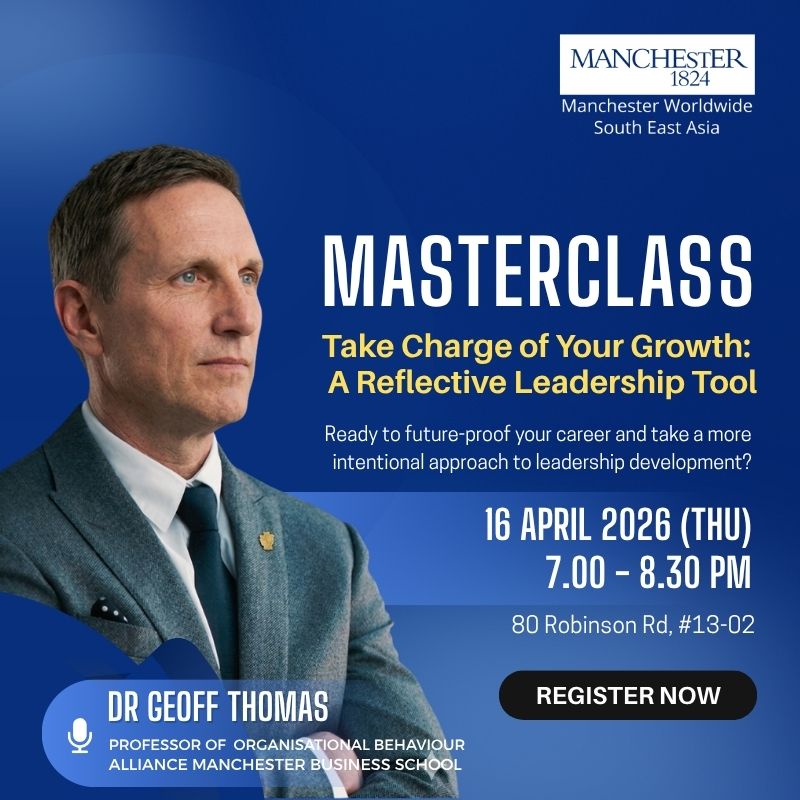
Masterclass: Take Charge of Your Growth: A… Through a powerful diagnostic tool, you’ll uncover personalised insights across four key strategies to accelerate your leadership development in dynamic environments. Walk away with clearer…